
When a mains failure hits a warehouse, underground parking garage, tunnel, factory floor or hospital corridor, emergency lighting is the difference between an orderly evacuation and a serious safety incident. The LED emergency twinspot light shown in this article is engineered for exactly those moments: a compact, wall-mounted emergency luminaire with two adjustable LED heads, an integrated rechargeable battery, and a robust IP-rated enclosure built for demanding industrial environments.
Whether you are an MEP engineer, electrical contractor, safety consultant or procurement manager sourcing emergency lighting for projects in Europe or the Middle East, this guide explains what a twinspot emergency light does, why LED technology matters, and how to select the right model for your specification.
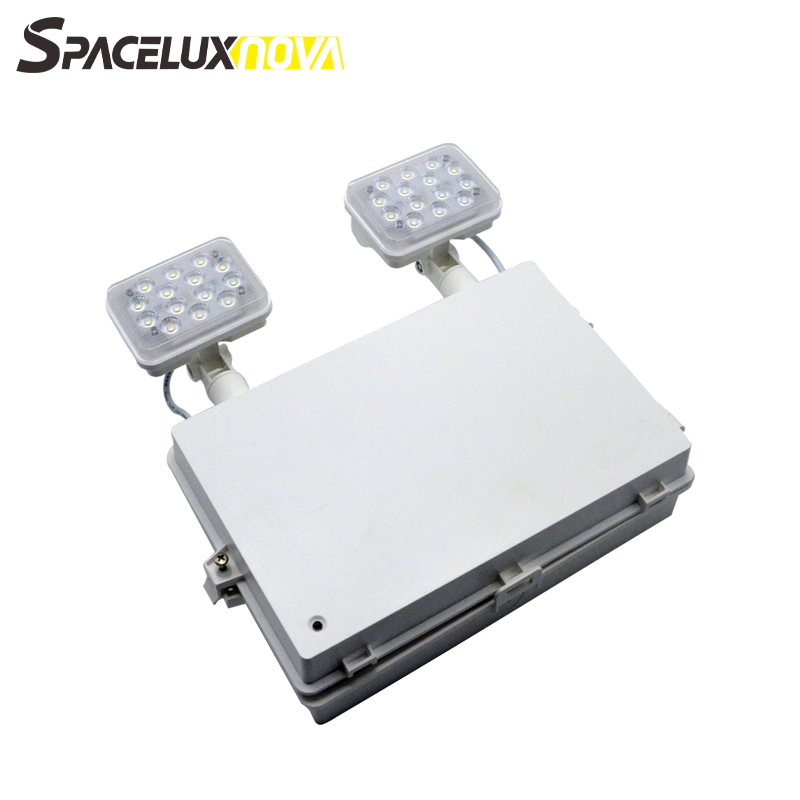
A complete LED emergency twinspot luminaire: twin adjustable LED heads, central driver/battery housing and surface-mount enclosure.
What Is an Emergency Twinspot Light?
An emergency twinspot light is a self-contained emergency luminaire that uses two spot-style LED heads to direct light toward critical areas during a power outage. Unlike bulkhead-style emergency lights that spread light in a wide, diffused pattern, twinspot units are directional: each head can be angled independently toward escape routes, firefighting equipment, changes of level, or high-risk task areas.
Twinspot emergency lights typically operate in one of two modes:
- Maintained emergency light – the fitting is lit during normal mains operation and remains lit at a reduced output during a power failure.
- Non-maintained emergency light – the fitting remains off during normal operation and switches on automatically when mains power is lost.
Both configurations rely on an internal battery backup system (usually Ni-MH or lithium-based) to provide emergency illumination for a regulated duration, commonly 3 hours under EN and IEC emergency lighting standards.
Product Overview: What the Images Show
The product photographs illustrate a modern, professional-grade LED emergency twinspot designed for commercial and industrial installation:
| Feature | What You Can See in the Photos |
| Twin LED heads | Two rectangular spot modules, each with an array of high-efficiency LEDs and individual optical reflectors for controlled beam distribution. |
| Adjustable mounting | Each head is mounted on a swivel joint, allowing installers to aim the beam precisely where coverage is needed. |
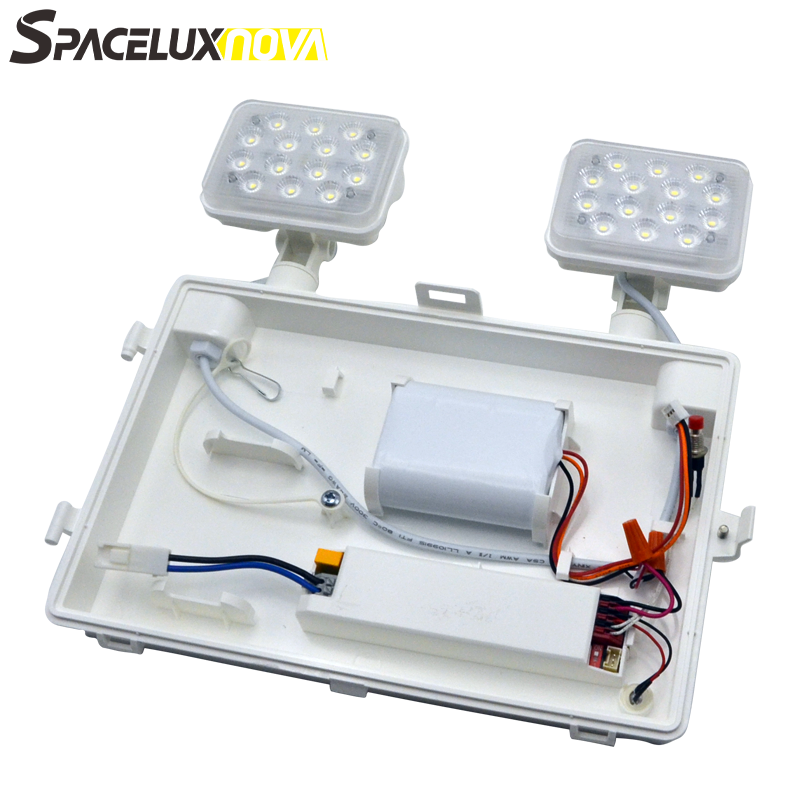
| Central control housing | A robust rectangular enclosure contains the LED driver, charge controller and rechargeable battery pack. |
| Quick-access terminal block | The open-case image shows clearly labelled terminals for L/N mains input and switched output, simplifying first-fix wiring. |
| IP65 enclosure | The sealed housing and gaskets protect internal electronics from dust and low-pressure water jets, making the unit suitable for warehouses, car parks and semi-outdoor locations. |
| Clean industrial styling | Neutral white finish blends into ceilings and walls in retail, healthcare, education and industrial buildings. |
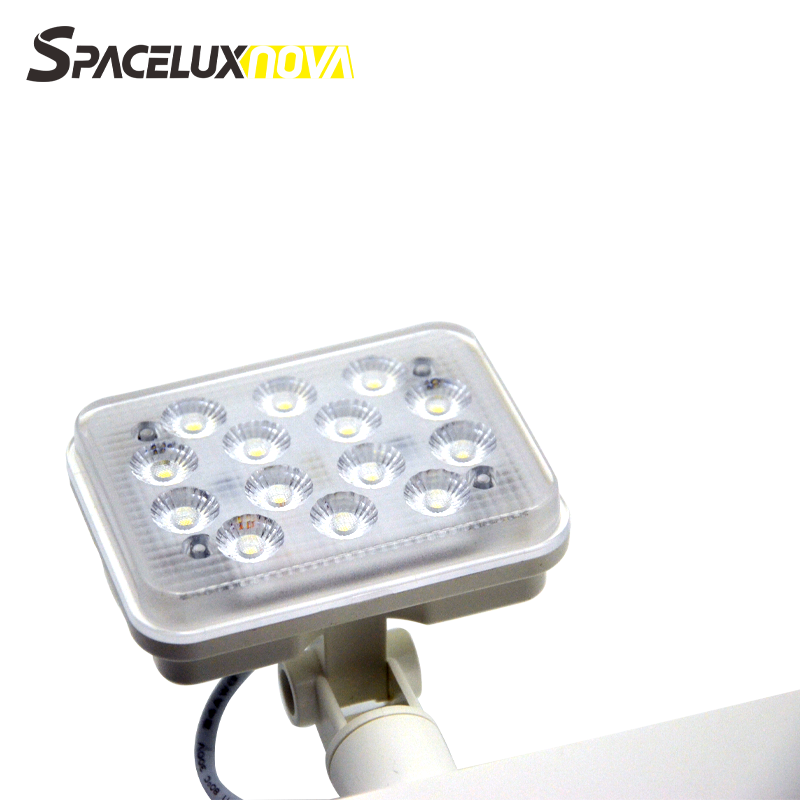
Close-up view of the LED spot head: multiple high-brightness LEDs with reflector optics for a focused emergency beam.
Key Technical Features & Benefits
1. High-Efficiency LED Light Source
The spot heads use multiple SMD LEDs arranged in a matrix. Compared with legacy halogen twinspots, LED technology offers:
- Longer lifetime – typically up to 50,000 hours, reducing replacement cycles.
- Lower energy consumption – important for maintained operation where the fitting runs continuously.
- Instant start – full output the moment mains power is lost, with no warm-up delay.
- Consistent lumen maintenance – the beam remains bright throughout the emergency duration.
2. Directional Twin-Head Design
Two independently adjustable heads provide flexible coverage. Installers can aim one head along an escape corridor and the other at a fire extinguisher or exit door, eliminating dark spots that single-head units can leave.
3. 3-Hour Battery Backup
The integrated rechargeable battery is sized to deliver the required emergency output for 3 hours, meeting the standard minimum autonomy in most European and Middle East building codes. Battery options include:
- Nickel-Metal Hydride (Ni-MH) – proven, cost-effective and widely recyclable.
- Lithium Iron Phosphate (LiFePO₄) – longer cycle life, lighter weight and stable thermal performance for hot climates.
4. IP65 Weather Protection
The sealed enclosure carries an IP65 rating, meaning it is dust-tight and protected against low-pressure water jets. This makes the unit suitable for:
- Industrial warehouses and loading bays
- Underground car parks and tunnels
- Food-processing plants with wash-down regimes
- External soffits and covered walkways in the Middle East
5. Maintained or Non-Maintained Operation
The same chassis can usually be configured as either a maintained emergency light (always on during normal power) or a non-maintained emergency light (emergency only), giving specifiers flexibility across different areas of a building.
6. Easy Installation & Maintenance
Surface mounting, hinged terminal access and plug-and-play battery connectors reduce on-site labour. Many models also offer:
- Remote-head capability – connect additional slave spot heads for wider coverage.
- Self-test function – automatic monthly and annual testing to reduce manual inspection costs.
- LED status indicator – a visual charge/fault indicator simplifies routine checks.
Internal view: rechargeable battery pack, LED driver/controller and quick-access terminal block for fast first-fix wiring.
Applications: Where to Install an LED Emergency Twinspot
Because of its directional output and durable housing, the LED emergency twinspot is used across a wide range of building types and engineering projects:
Industrial & Logistics
- Warehouses and distribution centres
- Production floors and assembly plants
- Loading bays and storage silos
Transportation & Infrastructure
- Tunnels and underpasses
- Underground parking garages
- Railway stations and airport concourses
Commercial & Public Buildings
- Shopping malls and retail stores
- Hospital corridors and clinics
- Schools, universities and office buildings
- Hotels and residential complexes
Hazardous & Special Environments
- Petrochemical and oil & gas facilities
- Water-treatment plants
- Server rooms and data centres
- Covered outdoor walkways exposed to dust, sand or humidity
In the Middle East, where high ambient temperatures, dust and occasional humidity place extra stress on luminaires, the IP65 enclosure and wide-temperature battery options make this format especially popular for car parks, logistics hubs and infrastructure projects. In Europe, it is widely specified under EN 60598-2-22, EN 1838 and local escape-route lighting regulations.
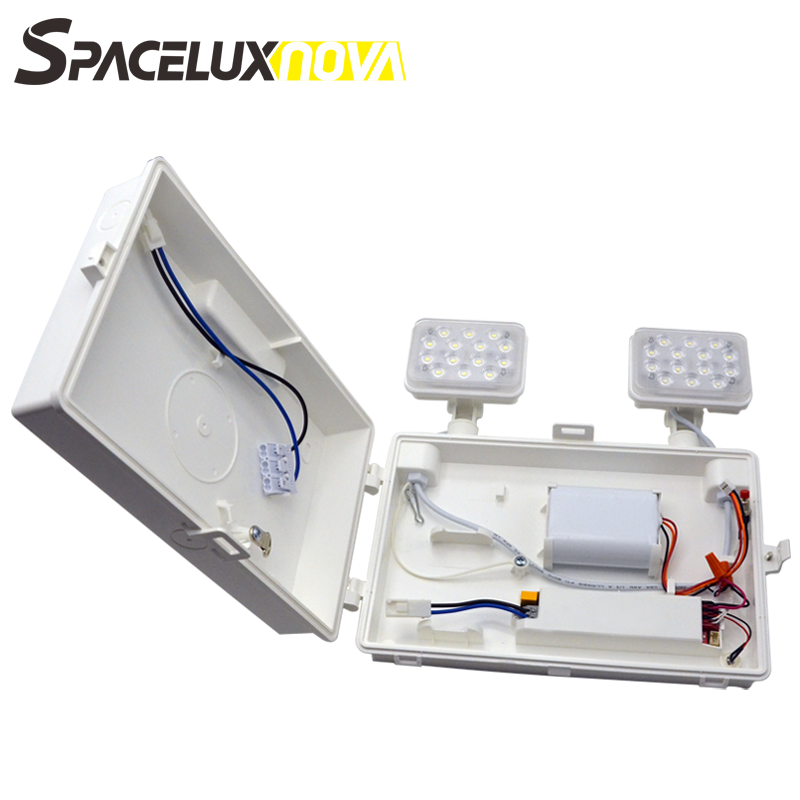
The hinged enclosure opens to reveal the terminal block and battery, making commissioning and future battery replacement straightforward.
Why Upgrade from Halogen to LED Twinspot Emergency Lighting?
Many older installations still use halogen twinspot emergency lights. Upgrading to LED delivers measurable advantages:
| Factor | Halogen Twinspot | LED Twinspot |
| Energy use | High (often 10–50 W per head) | Low (typically 2–5 W per head) |
| Lamp life | 2,000–4,000 hours | Up to 50,000 hours |
| Heat output | High | Minimal |
| Lumen maintenance | Degrades quickly | Stable over time |
| Maintenance | Frequent lamp replacement | Minimal |
| Battery runtime | Shorter / more demanding | Longer, lower drain |
For procurement teams, the lower maintenance burden of LED translates directly into reduced operating costs across large portfolios of commercial or industrial buildings.
Standards & Certifications to Look For
When sourcing emergency lighting for European or Middle Eastern projects, verify that the product documentation covers the following standards:
- EN 60598-2-22 – European standard for emergency luminaires.
- EN 1838 / BS 5266-1 – emergency lighting design and performance requirements.
- IEC 60598-2-22 – international safety requirements for emergency lighting.
- CE marking – mandatory for products placed on the European market.
- RoHS – restriction of hazardous substances.
- SASO / ECAS – relevant for Saudi Arabia and the UAE (confirm local project requirements).
Important: Always request test reports and certification copies from your supplier before placing an order. Certification requirements vary by country and project, so include them in your specification early.
Buyer’s Guide: How to Choose the Right Emergency Twinspot Light
1. Define the Operating Mode
Is the area normally occupied and lit? Use a maintained emergency light. Is it a back-of-house store or corridor that only needs illumination during a power cut? Use a non-maintained emergency light.
2. Check the Lumen Output and Duration
Ensure the unit delivers enough emergency lux on the floor or task area for the required time. A 3-hour autonomy is standard for most escape-route applications.
3. Verify the IP Rating
For dusty or damp environments, IP65 is the minimum we recommend. Wash-down or outdoor exposed areas may require IP66 or higher.
4. Consider Ambient Temperature
Middle Eastern projects often experience ambient temperatures above 40 °C. Specify batteries and drivers rated for the local climate, and ask the supplier for high-temperature test data.
5. Mounting and Coverage
Twinspot heads are usually wall- or surface-mounted. Calculate beam spread and mounting height so that each head covers the intended escape route or safety point without excessive overlap or gaps.
6. Battery Type and Replacement
Ask about battery chemistry, expected replacement interval and availability of spare batteries. LiFePO₄ batteries last longer but may cost more upfront; Ni-MH offers a lower initial outlay.
7. Warranty and Supplier Support
A reputable LED emergency lighting supplier should offer at least a 2–3 year warranty, clear technical datasheets, and responsive after-sales support for projects in Europe, the Middle East and Africa.
Why Source Your LED Emergency Twinspot Light from a Specialist Supplier?
At Spaceluxnova, we engineer emergency lighting for real-world projects, not just catalogues. Our LED emergency twinspot range is designed to help contractors and consultants meet strict safety codes while keeping installation and maintenance simple.
What our partners value:
- Project-ready specifications – detailed datasheets, IES files and installation guides.
- Flexible configurations – maintained or non-maintained, standard or self-test, multiple battery options.
- Regional compliance support – documentation to assist with CE, RoHS and Middle East conformity processes.
- Competitive export pricing – suitable for contractor bulk orders and distributor stocking programmes.
Whether you are tendering for a hospital in London, a logistics park in Dubai or a tunnel project in Riyadh, we can supply an LED emergency twinspot light that matches the technical and commercial demands of your specification.
Frequently Asked Questions (FAQ)
What is the difference between maintained and non-maintained emergency twinspot lights?
A maintained emergency light stays on during normal mains power and switches to battery power if the mains fails. A non-maintained emergency light is normally off and only illuminates during a power failure.
Is an IP65 emergency twinspot suitable for outdoor use?
IP65 protects against dust and low-pressure water jets, so it is suitable for covered outdoor areas, car parks and loading bays. If the fitting will be directly exposed to heavy rain or jet washing, consider IP66.
How long does the battery last in a power cut?
Most LED emergency twinspot units provide 3 hours of emergency illumination, which satisfies common European and Middle Eastern escape-route requirements.
Do LED emergency twinspot lights need regular maintenance?
Yes, but far less than halogen units. Typical maintenance is an annual duration test and, eventually, a battery replacement every 3–5 years depending on the battery type and operating temperature.
Can the two spot heads be aimed in different directions?
Yes. Each head is independently adjustable, allowing one luminaire to cover two separate critical areas such as a corridor and a fire extinguisher location.
Are these lights CE certified for Europe?
Our LED emergency twinspot lights can be supplied with CE documentation. Always confirm certification with your supplier before shipping, especially for tendered or government projects.
Get a Quote for Your Next Project
If you are specifying emergency lighting for an industrial, commercial or infrastructure project in Europe or the Middle East, we can help. Send us your project requirements, target quantities and destination country, and our team will prepare a tailored quotation and compliance documentation package.
Contact us today for your LED emergency twinspot light quotation, product datasheet or sample order.


